


Bruni & Campisi, Inc. helps homeowners navigate complicated plumbing decisions with practical guidance, and septic-to-sewer conversion is one of the more important long-term choices a property owner can face. If your home relies on a septic system and you are dealing with recurring issues, age-related concerns, or possible sewer availability nearby, it is worth understanding both the construction side and the county-program side of the conversation.
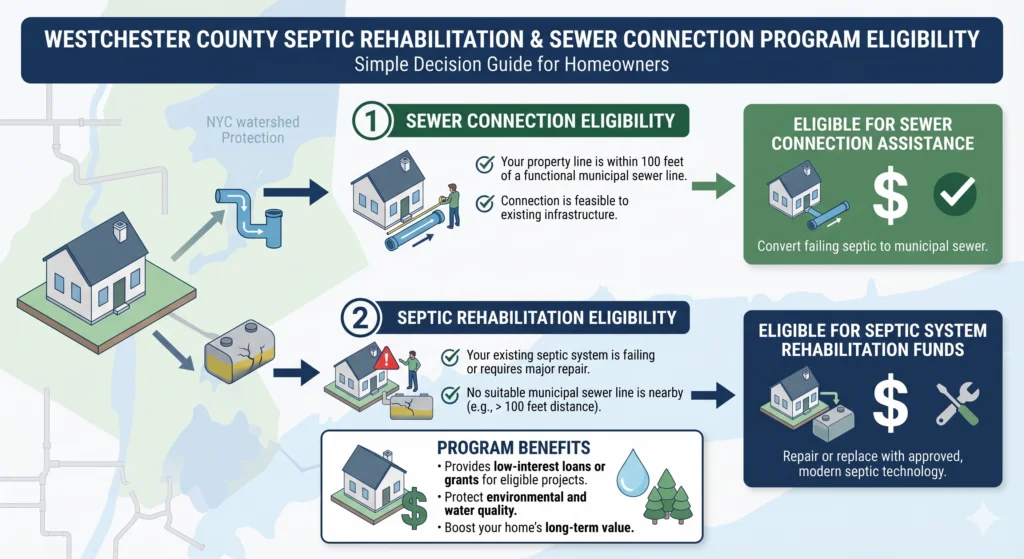
For some Westchester property owners, there may be financial assistance available through the county’s Septic System Rehabilitation & Sewer Connection Program. That program is designed to reduce health and environmental impacts tied to failing septic systems in the Croton and Kensico watershed areas. The eligibility rules matter, and homeowners should not assume the program applies automatically to every septic property in the county.
What homeowners need to know about septic to sewer conversion
A septic-to-sewer conversion generally means disconnecting a property from its on-site septic system and connecting it to an available public sewer line. For the homeowner, the benefits may include more predictable wastewater handling, reduced dependence on an aging septic system, and less concern about long-term septic rehabilitation.
But this is not usually a quick weekend project. Conversion work can involve permits, design, excavation, coordination with the municipality or sewer authority, connection requirements, restoration, and decommissioning the old septic components as required.
What is the Westchester County program?
Westchester County’s Septic System Rehabilitation & Sewer Connection Program is intended to reduce the health and environmental risks associated with failing septic systems in the NYC watershed. According to the county, the program provides financial assistance to income-eligible commercial and non-commercial property owners with on-site septic systems in the watershed who meet one of two criteria:
· The property line is within 100 feet of a sewer line, or
· The property has a failing septic system and no available sewer line within 100 feet from the property line for three years from the application year
That means the program is both location-specific and eligibility-based. Homeowners should verify whether their property is in the applicable watershed area and whether they meet the county’s financial and technical criteria before assuming funding will be available.
Why this matters for Westchester homeowners
Many Westchester homes are older, and some were built in areas where septic systems were standard long before nearby development changed service patterns. A system that once functioned adequately may now be expensive to maintain, prone to failure, or poorly suited to the current condition of the lot.
At the same time, septic problems are not just private inconveniences. They can affect property use, resale decisions, public health, and environmental compliance. That is why the county’s watershed-focused program exists in the first place.
Common reasons homeowners start considering conversion
Homeowners often begin the conversation when they experience:
· Repeated septic backups or slow drainage
· Wet areas or odors near the septic field
· Aging septic infrastructure with uncertain remaining life
· Planned home improvements that make septic limitations more obvious
· A nearby sewer line that may now create a better long-term option
A realistic example is the homeowner who has already paid for pump-outs, minor repairs, and troubleshooting, only to realize the system is still unreliable. At some point, replacement or sewer connection may become the more sensible investment.
What does the conversion process usually involve?
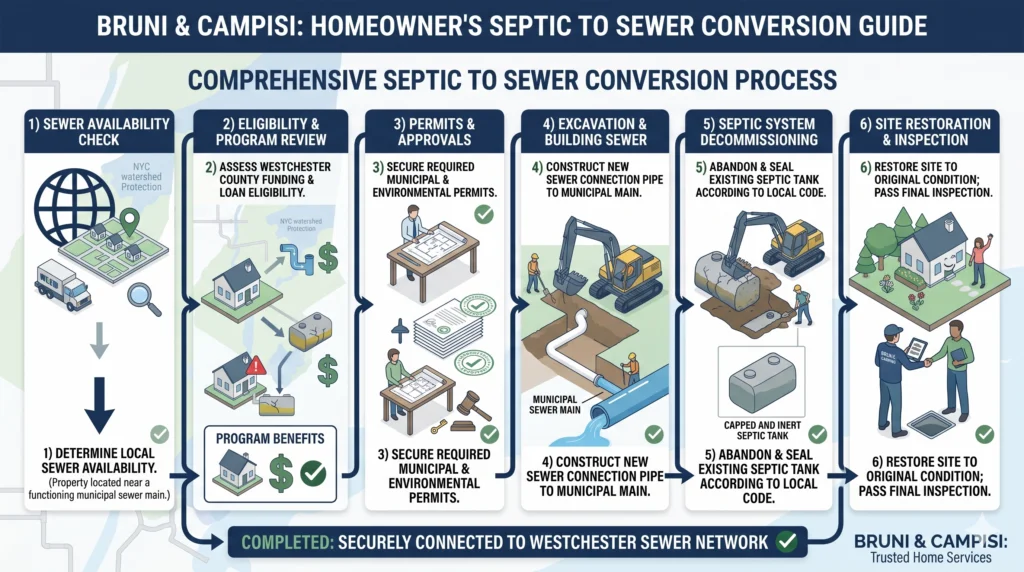
While every municipality and property is different, the process often includes:
1. Confirming whether public sewer is available and whether the property is eligible to connect
2. Reviewing county-program eligibility if financial assistance may apply
3. Securing required permits and approvals
4. Planning and installing the building sewer connection
5. Properly abandoning or decommissioning the septic system as required
6. Restoring the site and completing inspections
This is where experienced plumbing coordination matters. Conversion work touches the house, the lot, code requirements, and outside agencies. Homeowners need clear communication and realistic expectations.
How to know when you should contact a professional
Call for guidance if:
· Your septic system is aging or showing warning signs
· You have heard that sewer may be available nearby
· You are planning a sale, addition, or major renovation
· You want to understand whether county-program assistance may be worth exploring
· You need help sorting through the practical difference between repair and conversion
Bruni & Campisi, Inc. can help homeowners think through the plumbing side of the project and the questions they should be asking early.
Call Bruni & Campisi today for reliable plumbing guidance and service in Westchester.
Frequently Asked Questions About Septic to Sewer Conversion
Does every Westchester homeowner with septic qualify for the county program?
No. The county program is limited and applies to income-eligible property owners with qualifying septic systems in the applicable watershed area who meet the program criteria.
What if my property is close to a sewer line?
That may be important. One of the county criteria involves having a property line within 100 feet of a sewer line.
Can a failing septic system qualify if no sewer line is available nearby?
Potentially, under the county program, a failing septic system with no available sewer line within 100 feet may qualify under the separate three-year criterion.
Should I repair my septic system or convert to sewer?
That depends on the condition of the septic system, sewer availability, project cost, and your long-term plans for the property.
Need fast help understanding your plumbing options? Contact the Bruni & Campisi team to schedule your service.
For over 40 years, Bruni & Campisi has delivered dependable service to communities across New York and Connecticut. If your septic system is becoming a recurring problem or you want clear guidance on whether sewer connection may be possible, now is a good time to start the conversation. Stay comfortable year-round — book your appointment with Bruni & Campisi today.

MEMBERSHIPS
Bruni & Campisi offers a complete maintenance program for all your needs.
VIEW MEMBERSHIPSWhat Our Customers Say About Us
Glen visited today to correct water flow to the expansion tank of the hot water heater. He is very professional and gave a clear and concise description of what was changed and corrected. I would definitely recommend his work to my neighbors and friends!
Show More
mary pumillo
Glen fixed an issue that three other plumbers couldn’t resolve! He was friendly, professional, and saved me money by getting to the root of the problem. I’m so grateful to have found him and highly recommend him to anyone looking for a knowledgeable, reliable plumber.
Show More
Jelena Richard
I had Bruni and Campese replace all the Angle stops for my facets and toilets. The next day there was a problem with a few of the facets. They sent out Glenn who not only fixed the problem facets but cleaned out the sediment in all the other facets to make sure they would work well. Glenn is very experienced, personable and nice. He is the best. I would recommend asking for him.
Show More
Andy Cohen
Fiona from Bruni and Campisi visited our home to conduct a plumbing inspection and was an incredibly polite, pleasant, and educated technician. She was mindful and respectful of our home as she conducted her checks and did an excellent job of explaining what she was testing for throughout her visit. She relayed results in real time and took the time to thoughtfully answer our questions and offered practical and realistic solutions to items that needed attention. Fiona was prompt, knowledgeable, and efficient and we are looking forward to working with her on continued maintenance of our home.
Show More
Catherine Moreno
Fiona inspected our plumbing. She was very thorough and efficient.
Show More
Linda Meltzner
Fiona O’Dwyer came by today for a plumbing inspection and was incredibly knowledgeable and professional. She explained every issue in the house clearly and thoroughly, and even provided us with three different quotes. Overall, it was a fantastic experience working with her.
Show More
Claudia Vargas
Glen did a great job fixing the issue with my toilet and explaining routine maintenance that I should be doing over time to prevent further breakdown
Show More
Jordan Adelman
After recently moving into a new home I had an unexpected and strange issue with my kitchen sink and the connected dishwasher. I contacted Bruni and Campisi . Glen Gentle, a seasoned Plumber was sent soon after. Glen is a friendly, and a super knowledgeable Plumber at Bruni and Campisi. He was able to determine my kitchen drain issue right away. Glen pointed out the problems and thoroughly explained everything to me and how it could easily be corrected. He was fast professional and focused. The project was finished recently and I couldn’t be any happier with my updated kitchen sick repairs. This was my first time using Bruni and Campisi. I learned they can help me with a variety of other home repairs and issues I will desperately need. I will definitely call them again as well as recommend them to my neighbors and friends. Thank you Glen Gentle and Bruni and Campisi.
Show More
Amy Huelsman (Amy Huelsman)
Sérgio was a very talented and knowledgeable professional. He was the first one able to solve our issues with a very clogged bathtub. We have tried every thing, including calling some other companies, but Sergio from Bruno & Campisi was the only one with the patience, professionalism and willingness to try different approaches until he finally solved the problem. We are extremely grateful for his service and will certainly call him again if we need help with anything related to plumbing in our place. Thank you so much!
Show More
Ana Turkienicz
Manny came to my home to find a leak in my gas pipe. He found it within the first 10 minutes and had the pipe apart and back together in no time! While working he explained everything he was doing and why. He was incredibly professional the whole time. He is invited back any time!
Show More
Andrew Ricci
Hunter came out today after we had a sewer backup. He was very knowledgeable, thorough, and professional. He explained every step of the process and showed us what he was seeing on his camera. I would highly recommend them and will definitely be using their services in the future!
Show More
Matthew Lubera
This was my first time using the company, and I had a great experience with Glen. He came out to clear a badly clogged kitchen sink and was incredibly professional, knowledgeable, and thorough. He took the time to make sure everything was completely cleared and working properly, and he was extremely clean and careful throughout the process. What I especially appreciated was that Glen went above and beyond the actual repair — he even took the time to clean out the debris underneath my sink before he left, which I certainly wasn’t expecting! He was friendly, respectful of my home, and clearly takes pride in his work. I would absolutely request Glen again and highly recommend him to anyone needing a plumber.
Show More
Jessica Wren
Was really happy with the plumbing inspection that John performed today. He was thorough and explained everything in detail. He took the time to find the best product for my house and explained the installation process.
Show More
monica hashimoto
Double header! First, John gave my home a top-notch thorough plumbing inspection and found some problems plumbers never unearthed over the last 20 years that were the root of other problems. Great job. Then Daniel B. and D'Vante cleaned the ducts and were a great team, making sure they got to ever nook and cranny. High five!
Show More
Jane O'Reilly
Second visit from Bruni & Campisi after the water heater broke down. Jason Rees was phenomenal: he explained very well what happened with the heater, he drained it completely so it wouldn’t leaked anymore (which kept happening after water was shut off), contacted the manufacturer since the heater was under warranty, and soon we should be getting the new one installed. Thanks a lot Jason!
Show More
Augusto Gallipoli